What Evidence Does Chavez Offer to Make the Case for Banning Pesticides
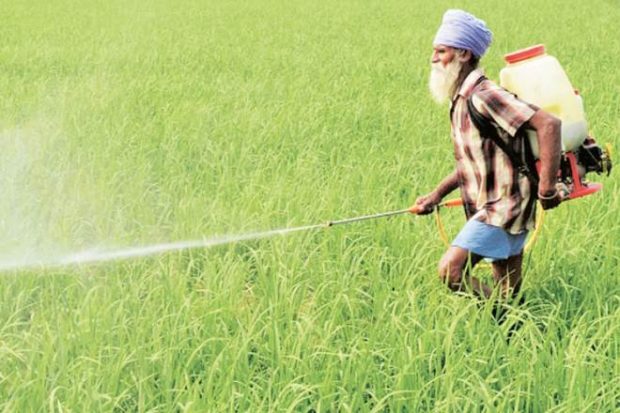
Farmers and the pesticide industry are agitated over three notifications issued since February that take proposed bans on about 30 chemical pesticides and restricted the spraying of glyphosate, a pop weed killer, only past licensed pest control operators. Do these bans and restrictions have a scientific basis?
The 27 chemicals proposed to exist banned were identified past the Anupam Varma committee prepare in 2013. Of these, 12 are insecticides, eight fungicides and 7 herbicides. In terms of toxicity, six are greenish triangle or 'unlikely harmful', eight are blueish triangle or slightly toxic, while the rest are moderately (2), highly (7), and extremely toxic (four).
A reason for the ban cited in the notification is the companies or industry associations did not submit reports of studies which the committee advised. When Crop Care Federation of India, a group mainly of Indian companies, was confronted with non-compliances, its chief scientific adviser Jagadish C Majumdar gave a molecule-wise reply. He said iv molecules are not being defended then no studies were done. For 13 molecules, the required data has been given. For nine molecules, nigh just non all the data has been given. In 1 case, studies are nether way.
According to the pesticide association, the deportment of the authorities abridged the two-year time for completion of studies. The Registration Committee (RC) added new studies in improver to those recommended past the Varma committee. In view of these developments, the RC decided in April 2019 to extend the deadline for completion of studies to the finish of last December, but then in July information technology reversed the conclusion, saying that the agriculture ministry had overruled information technology.
The reasons cited in the typhoon gazette notifications beguile an eagerness to ban. The listing of countries where the chemicals have been prohibited are fatigued from the Pesticide Action Network website, an advocacy against chemic pesticides. Some of the countries cited—Syria, Kingdom of saudi arabia, Ivory coast, Chad, Suriname, Mozambique, Palestine, Tongo and Senegal—cannot exist models for an agricultural major like India. The United kingdom of great britain and northern ireland'southward Pesticide Properties Database, suggested as a reference site by the Indian Agricultural Research Institute's (IARI) division of agronomical chemicals, says that of the 27 chemicals, 20 are approved for use in Commonwealth of australia and xviii in the US. In the Eu, thirteen are in utilize across all the 27 member-countries or in some of them, or they are approved but inactive.
A letter written by RK Chaturvedi, secretarial assistant, Department of Chemicals and Petrochemicals, to the agriculture ministry building on June ii shows picayune inter-ministerial coordination. He said in that location should be "wider stakeholder consultations" before further action is taken.
When contacted, Anupam Varma said the RC must "re-review" its decision to ban 27 chemicals. At a contempo online conference, agronomics commissioner SK Malhotra said that the advantages of a constitute protection chemic are known upfront, just their menacing aspects get discovered over time. But quondam demand not mean dirty. All molecules go through a rigorous process of approving. As new noesis becomes available, the molecules volition have to be reviewed. The European union does this every 10 years; the US every 15 years. India must likewise move from advert hoc reviews to 10-year ones, as the Varma commission suggested.
India must also non allow the European union or any land to set its pesticide standards. The EU reduced its maximum residue level (MRL) for tricyclazole, a fungicide used for control of neck blast in rice, a hundred-fold to 0.01 parts per million (ppm) or 1 milligram per 100 kg from Jan 2018. Rice exporters faced rejection of consignments when traces of the chemical were establish and wanted the fungicide banned. The MRL for the fungicide in the United states of america is iii ppm and in Japan 8 ppm.
Anupama (no surname), the caput of IARI's agricultural chemicals sectionalization, says there is a need for global harmonisation of pesticide MRLs through the World Wellness Organisation (WHO). Ashok K Singh, manager, IARI, says nations will assert their right to fix food safety standards. Buyers will dictate terms. In 2017-18, the European union imported 3.93 lakh tonnes of Indian basmati; the top five West Asian countries bought 2.69 million tonnes. Singh says tricyclazole use could perhaps exist prohibited only in Sirsa and Fatehabad districts of Haryana, which can encounter India's basmati exports to the Eu.
The government'south brake on the use of glyphosate—to be sprayed only by pest control operators—is inexplicable. The RC admits the herbicide is internationally classified as "slightly hazardous." The WHO's cancer research bureau, the IARC, says it is "probably carcinogenic to humans" based on "express" prove in humans and "sufficient" evidence in experimental animals. The states juries take recently imposed damages on Bayer CropScience which sells the chemical under the brand Roundup. Bayer has besides agreed to settle the lawsuits for $ten.5 billion, but has not admitted any harm. It is highly-seasoned the trial court orders. The US Environment Protection Bureau has not banned the product. The EU has approved its utilise till December 2022. Nevertheless the RC said it is banned in 20 countries citing Sustainable Pulse, a group that is opposed to chemical agriculture and GM crop engineering.
Glyphosate is extensively used on crops like cotton, maize and soybean, which are genetically-modified to exist resistant to it. In India, only a fifth of the cotton area is, illegally, planted with herbicide-tolerant cotton. Other farmers use information technology judiciously, unlike in the Usa or the European union. Pritam Singh, a progressive farmer of Sonipat, Haryana, who produces wheat and rice seed on 117 acres mainly for the IARI, says he sprays simply 8 kg of glyphosate a year to remove weeds on the edges of fields. Milind Damle, a cotton grower of Yavatmal in Maharashtra, says it will cost him Rs 6,000 to remove weeds on an acre manually, whereas with glyphosate he can practice the task in just Rs 1,000.
The writer blogs at smartindianagriculture.in. Views are personal
Source: https://www.financialexpress.com/opinion/banning-pesticides-make-haste-slowly/2060146/
0 Response to "What Evidence Does Chavez Offer to Make the Case for Banning Pesticides"
Post a Comment