Get Duration of Uploaded Song Through Input Type File
The easiest way to apply Audacity is to import an existing sound file and make pocket-sized changes. If you lot have never used Audacity earlier, this is a peachy identify to start.
 | If you have just fabricated a recording it is strongly recommended that you immediately export your sound using to WAV or AIFF (ideally to an external drive) as a prophylactic copy before y'all start editing the project. |
Objective
The objective of this tutorial is to learn how to edit an sound file. To achieve this objective, we are going to import an existing sound file, remove all only 10 seconds of this file, employ a 1-2d fade-out at the end, consign the results, and play it in your favorite audio player. These steps will innovate the basic steps commonly used when editing the contents of an audio file.
Step 1: Find a file to edit
Audacity can import many common sound file formats, including WAV , AIFF , and MP3 . If the optional FFmpeg library is installed, a larger range of formats, including WMA and the audio content of about video files, can be imported. Audacity cannot import re-create-protected music files.
If you want to edit music that you accept on an audio CD , yous need to "rip" the music into an sound file. See the Sound CDs folio for information on getting the sound off of CDs and into Audacity.
No sound files handy? In that location is lots of gratuitous music online.
Footstep two: Import the file into Audacity
First launch Audacity, then import an sound file by selecting .
A quicker method is to just drag and drop the file as in the following examples:
 |  |  | |||
| Windows: Drag the sound file icon into the open Audacity window. | Mac: Drag the audio file icon to the Brazenness icon in the Dock (does non work for all formats yet). | Linux: Drag the audio file icon into the open Audacity window. |
All iii platforms support:
- dragging the sound file into the Audacity window
- dragging the audio file to the Audacity icon on the Desktop.
Specific dragging behavior according to platform:
- On Windows and Mac you can also drag to Audacity'south icon in a file manager application.
- On Mac and Linux you can elevate the file to the Audacity icon in the Dock or Taskbar respectively to import the file into Audacity.
- On Windows, dragging the file to the Audacity icon in the Taskbar will either switch the window to Audacity if it is running (from where yous can drag the file in), or if Audacity is closed, give the choice to launch Audacity with the file imported.
Command-line file importing: On all three platforms yous can too import files by launching Audacity at the command-line and passing the files you wish to import as arguments. For case, on Linux Ubuntu:
[electronic mail protected]:~$ brazenness Desktop/song.mp3 Desktop/spoken language.wav
imports the "song.mp3" and "spoken language.wav" files located on the Desktop in separate Audacity windows.
Step iii: Wait at the waveform

This image above shows a stereo waveform. The left channel is displayed in the meridian one-half of the runway and the right channel in the bottom half. The rails proper name takes the name of the imported audio file ("No Town" in this example). Where the waveform reaches closer to the top and bottom of the rails, the sound is louder (and vice versa).
The ruler above the waveform shows you the length of the sound in minutes and seconds.
Removing whatsoever DC commencement (if present)
DC outset can occur in audio files and then that the recorded waveform is not centered on the horizontal line at 0.0 aamplitude . It can be caused by recording with a faulty audio interface. The example in a higher place is centered on 0 correctly and carries no DC offset. If your waveform is not centered, come across the Normalize page for how to utilize Normalize to remove DC offset and how to check if your Windows sound device tin perform this correction automatically.
Footstep iv: Listen to the imported audio
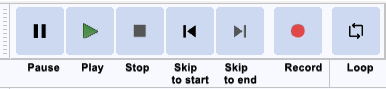
The image above shows Transport Toolbar.
Click the Play button  to heed to the audio. Click the Stop button
  to stop playback. If you do not hear anything, see Audacity Setup and Configuration.
Yous can utilise the Space key on the keyboard as a shortcut for Play or Stop.
Click on Selection Tool  so click on the waveform to cull a place to start, then click the Play push . Click and elevate to create a selection, and and then when yous click Play button merely the selection volition play.
Keyboard utilise: You lot tin select audio entirely using the left arrow, right arrow and other keys.
- Printing Left or Correct to move the cursor left or right respectively in the waveform.
- Hold down Shift while pressing Left or Right to create then extend a selection leftwards or rightwards respectively.
- Agree down Shift and Ctrl while pressing Left or Right to contract an existing selection leftwards or rightwards respectively.
Clicking the Skip to Kickoff button  or pressing the Habitation fundamental will move the cursor to the first of the rails. It is similar rewind, but it is not for playback - information technology volition only work when playback is stopped.
Similarly, clicking the Skip to Finish button  or pressing the End key will move the cursor to the finish of the track.
To jump the playback position forwards or backwards from where it is now, click on the Timeline above the waveform at the point yous wish to hear.
Keyboard use: You can use the following keys to skip around the audio file while listening.
- Printing Left or , to move the playback cursor back one second.
- Press Right or . to motion the playback cursor forward i second.
- Press Shift + Left or Shift + , to move the playback cursor dorsum 15 seconds.
- Press Shift + Correct or Shift + . to move the playback cursor frontward 15 seconds.
The amount the cursor moves in this situation is chosen the "seek time". The long and short seek times (i second and xv seconds in the examples above) tin can exist set in the Seek Fourth dimension When Playing section of Playback Preferences.
Step 5: Create a ten-second clip from your sound
You edit sound waveforms in Audacity in much the same way as yous would edit text in a word-processing document. When you are editing text you offset select the text you desire to modify and then choose what you desire to exercise with it. You might desire to cutting or re-create the text, delete information technology, paste new text in its identify, or change it to assuming. You do the aforementioned thing in Audacity: beginning zoom and select the range of audio you want to modify, and then choose what you want to practice with it.

The image higher up shows Edit Toolbar with the Zoom buttons highlighted. This  is the Zoom In tool, and this
  is the Zoom Out tool.
To zoom in to become a closer look at the waveform, first choose the Selection Tool , and so click near the bespeak yous are interested in, then click the Zoom In button. Proceed clicking the Zoom In button until you meet the detail you demand. Note that when you lot click the Zoom In button the cursor is centered on the screen.
At that place are as well carte du jour commands and keyboard shortcuts for zooming. (or Ctrl + ane) is the aforementioned as clicking the Zoom In button. (or Ctrl + 3) is the same as clicking the Zoom Out push. (or Ctrl + F) will zoom the waveform so it fits in the window.
Apply the Zoom commands so that you can make maximal utilise of your Audacity window to see as much detail equally you need, or to make sure you lot see the entire file when necessary.
Walk through deleting all just approximately x seconds of selected audio
To cut this sound file down to exactly 10 seconds, apply these following steps.
 | These steps require a mouse, except for using Space on the keyboard to play the selection and C to play either side of the selection. See below for how to create and adjust selections using the keyboard. |
- With playback stopped, click near the point where you want the 10-second slice to begin.
- Zoom in until the Timeline shows 10 seconds or more before and afterward the cursor.
- While holding downward the Shift key, click 10 seconds to the right of the cursor.
- Note that this is just similar selecting a range of text in a discussion processor

- Press Space to listen to the unabridged selection. Playback will cease when the end of the choice is reached.
- Adjust the start and end of the choice with the mouse as follows.
- 5.1. Move the pointer over the start of the selection - the cursor volition change to a left-pointing hand.
- 5.2. Click and elevate to adjust the beginning of the selection.
- 5.3. You tin can adjust the end of the selection in a similar way.
- Printing Infinite to listen to the adjusted choice. You do not have to mind to all of it; press Infinite again at any fourth dimension to end playback.
- A user-friendly way to listen to just the adjusted start of the selection is to move the mouse pointer a niggling after the offset of the option so press B. The selection plays from the start of the selection to the pointer. To hear the adjusted terminate of the selection, move the pointer close to the selection end, then press B to play from the arrow to the option terminate.
- You can as well play a length of audio either side of the choice by pressing C. This lets y'all make certain there is no sound you want to proceed that will exist removed. Playing either side of the selection would also exist useful if y'all later wanted to cut a minor slice out of that option - you would select the small piece to be cutting, and then could preview how the audio would sound after the cut. To adjust the length of audio played before and later on the selection, go to Cut Preview in the Playback Preferences.
Keyboard use: Utilize the arrow keys to arrange the selection start and stop.
- Pressing Shift + Left will expand the selection to the left.
- Pressing Shift + Right will expand the selection to the correct.
- Pressing Shift + Ctrl + Left volition contract the selection from the right.
- Pressing Shift + Ctrl + Right will contract the selection from the left.
Keyboard employ: Employ Choice Toolbar to create or adjust a selection.
- Without a mouse, utilize Ctrl + F6 to navigate into Selection Toolbar, and then Tab between the controls.
- In "Choice Offset", blazon the starting point of your selection if there is not yet a pick.
- Select the
 Length radio button higher up the second grouping of numbers in Pick Toolbar if information technology is not yet selected.
 - If there is no selection even so, select the digit subsequently the "m" in the "Length" box and type 1 (one) on your keyboard. This selects exactly 10.000 seconds from the starting signal yous chose.
- In one case there is a selection, you can adjust its length in the same fashion. Let's suppose you dragged a piddling less than 10 seconds in the waveform, but you lot need the selection to be exactly 10 seconds.
- Select the first digit to the right of the decimal point in the "Length" box.
- Type 0 (zero) - the digit changes to zero, the digit to the right is selected and the selection in the waveform changes to match.
- Blazon 0 (zero) twice more - the selection length is now 10.000 seconds, accurate to i thousandth of a 2nd.
You accept now selected the portion of the audio that you desire to keep. Make sure you have pressed Infinite to stop if the runway is still playing, so to delete everything except the selected audio, click on .

If y'all make a fault, you tin can ever click on . Audacity has unlimited Undo and Redo. Yous can undo your editing deportment all the way back to when you lot imported the file. Y'all tin also Redo deportment that you accept undone.
You now have a region of audio that starts several seconds (or perhaps minutes) from the outset of the runway. You could move the sound to the beginning of the track, using , just this is non a necessary stride considering when exporting, Audacity will ignore the white space between time nothing and the commencement of the sound.
Step 6: Fade out the concluding second
- Click the Skip to End push .
- Zoom In until you lot can see the terminal two or three seconds of the waveform.
- Click in the waveform about ane 2nd earlier the stop.
- Click on .
- Click on . The terminal second of the sound is smoothly faded out.
Note that we always select some audio first, then choose what action we desire to perform on it.
Step 7: Consign the resulting file
When you salve an Audacity project with you are doing just that - saving an Audacity project. Brazenness projects can be opened but by Audacity. If you desire other applications (such as Apple Music/iTunes or Windows Media Player) to exist able to open this file y'all need to consign it.
Before we export this ten second clip to a separate file we are going to simplify things a bit. Go to the Import / Export Preferences, and under When exporting tracks to an sound file uncheck "Evidence Metadata Editor prior to export stride". Metadata Editor adds extra information about the voice communication or music into the file - see For More than Information below to learn more. You can go back to the Import / Export Preferences at whatever time to re-enable Metadata Editor.
Exporting a WAV file
- Click on - the standard "Relieve" dialog for your operating organization appears.
- Give the file a different proper name. Audacity always suggests a name for the file that is the aforementioned every bit the proper name of your Audacity projection. It is always best to alter this then you exercise non misfile your exported file with your Brazenness project.
- Choose a location to save the file in the usual style.
- At the bottom of the Salve dialog is a dropdown carte labeled "Format". From this menu choose "WAV (Microsoft) signed sixteen-chip PCM".
- There are no options for the WAV file format, so in that location is no need to click the push.
- Click the push button to complete the consign of your project to a WAV file.
Exporting an MP3 file
The steps for exporting a file in MP3 format are the same equally for a WAV file, except:
- In the Save dialog, from the "Format" menu, cull "MP3 files"
- Then click the push button to prepare the chip rate and other options for the MP3 file.
Footstep 8 - Testing your new Audio Production
To demonstrate the difference between an Audacity project (the AUP) file, and a sound file you export from an Brazenness project:
- Click on , saving changes if asked.
- Find the AUP file on your computer and attempt to open it with the audio player of your option (for example iTunes, Windows Media Player). You cannot.
- Find the exported WAV file on your estimator and attempt to open it with the audio player of your selection. Success!
You cannot open an Audacity project in a media histrion. Only past exporting your project tin yous listen to it in a media actor.
Once yous have exported your projection you may desire to go along the original projection file (AUP3) around in example y'all want to make some changes to information technology in the time to come.
Where to get from here
More tutorials
- Tutorial - Your First Recording
- Tutorial - Mixing a Narration With Groundwork Music
For more data
- Opening or Importing Sound Files: File Card > Open, File Menu > Import
- Tracks and Waveforms: Audio Tracks, Audacity Tracks and Clips, Audacity Waveform
- Playing a file: Playing and Recording
- Editing a track: Edit Menu, Zooming
- Effects: Effect Menu
- Saving: Audacity Projects
- Exporting: File Carte du jour > Export...
- Metadata Editor: Metadata Editor
- MP3 Consign Options: MP3 Consign Options
Source: https://manual.audacityteam.org/man/tutorial_editing_an_existing_file.html
0 Response to "Get Duration of Uploaded Song Through Input Type File"
Post a Comment