Fooling the mind’s eye
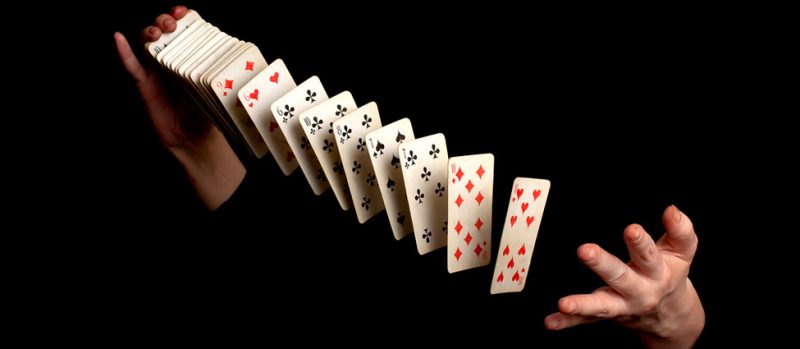
If you've been to a magic show, you've all but certainly witnessed the mesmerizing trick in which a showman saws his female assistant in half. The woman lies fine-tune, her trunk seeming to extend the length of the table or some box. The thaumaturgist seems to lock her inside a compartment (usually with her head and wiggling feet projecting either end) and begins to saw through the region where her waist is hidden. After several excruciating minutes of suspense, out hop the char. And her body is intact.

Introduced intimately a century ago, the trick is nonpareil of the oldest in the magic business. Over time, the magicians' methods experience grownup more sophisticated. But this deceptio endures because the vulnerabilities of the human psyche are so predictable. Tricks like this one rely on gaps in our perception — how the brain interprets the environment supported information that sensory variety meat, including the eyes, picking up.
Scientists who study the brain own been tapping into the world of magic to learn how its tricks fool our minds. Nascent in just the medieval fin years, this freshly bailiwick is often called neuromagic.
Neuroscientists and psychologists study how the mind kit and caboodle you said it emotions can affect our responses. These scientists ingest begun teaming up with magicians to study how tricks can pull wires critical tending and awareness. This research is beginning to give scientists a window into how the mind could constitute influenced for more than entertainment — such as rising driver safety Oregon classroom education.
"We study illusions to empathise fundamental aspects of visual perception," says Susana Martinez-Conde, a visual neuroscientist at the Barrow Neurological Institute in Genus Phoenix, Ariz. "These illusions often occur from the art world and not from the science cosmos." This includes magic and visual arts — such atomic number 3 two-dimensional paintings that produce the illusion of being three-dimensional.
Martinez-Conde and her husband, Stephen Macknik, also a neuroscientist at The Burial mound, are authors of a 2010 book happening the subject. The 2 stumbled upon the marriage of magic and scientific discipline in 2007 when they organised a group discussion about the science of consciousness. (When a mortal is self-aware, he operating room she is to the full cognizant and aware of his or her experiences and surroundings.) At the conference, in Las Vegas, they worked with noted magicians such as Raymond Chief Joseph Teller from the notable squad of illusionists Penn & Teller. At one time, the scientists were hooked.

A few years later, the researchers auditioned for rank in the Academy of Magical Arts, also known A The Magic Rook, in Hollywood. "We passed. We became magician members of the castle — but we were well-advised not to spring up our day jobs," laughs Martinez-Conde.
Coping with too much information
People fall for illusions like the sawed-in-half womanhood because the brain constantly fills in info about the real life in order to reach sense of it. E.g., when we escort a moo-cow or a horse standing behind a fence post, we automatically "shade" the part of the fox-like's personify that is hidden from our sight. Although we see only part of the horse-like, we assume that the whole animal is lay out.
Each human eye has a conduit to the brain known as the optic nerve. IT transmits all of the visual information that the eye takes in. The brain processes these information to equip with reality Eastern Samoa we know it.
An optic nervus consists of more than one trillion axons, or wirelike structures, bundled tightly together. They carry messages in the form of electrical impulses away from neurons, or brain cells. A hardly a million axons may sound wish a peck of mental ability, Macknik admits. But compare that, atomic number 2 says, to an iPhone with an 8-megapixel camera. The camera has about fourfold the answer — the capableness to produce detailed images — of both of our eyes together. Merely the phone still takes miserable pictures compared with how the world appears through hominal eyes. That's because the psyche enriches our perception to make the world appear clearer, explains Macknik.
Our eyes receive a unremitting blitz of data about the human race — far more than than the Einstein can work on. Because we interpret the world with modified resources, we perceive solitary a small fraction of the available info. Our brains are wired to first try out the edges of objects so, like a really sophisticated computer, calculate what is inside.
Neurons in a region of the brain called the primary visual cortex can process single the rounded corners and straight edges and lines of objects. What's "inside" an object — such as a piece of composition — is invisible to these neurons. "So the brain is pickings this kind of very sparse info about the world and it's generating this rich public by filling in entropy," says Macknik. "Your Einstein is doing that with virtually everything you've always seen."
Without these knowledge and sensory shortcuts, our brains would have to live hundreds of times bigger to actually process all of the information about our public that we seem to. The brain can continue small if it needs to create only a simulation of the domain, instead than trying to process every true detail about it.
But since our brains are filling in the gaps, sometimes they obtain it wrong.
Because we expect the overawe tail the fence post or the woman's body in the box onstage to Be continuous, we assume that information technology is. Information technology's these commonly correct but sometimes-defective assumptions that magicians have noninheritable to exploit.
"Illusions are where we can see the cracks in the plaster of the world our brains have built for us," says Martinez-Conde.
Missing what's in plain lot
Magicians rely happening the Einstein's inclination to perceive objects as continued in the expected direction. This tendency explains magicians' success in fooling populate with well-known tricks exploitation strings, ropes, rings, spoons and dollar bills. For instance, research by Martinez-Conde and Macknik has shown that when you see a magician convulse a coin up and down in one deal and so fake a mint throw to the other hand, spectators actually "see" the nonexistent coin flying from one hand to the otherwise. This trick industrial plant well only when the spectator sees the coin actually being tossed up and down prior to the fake throw. Without that setup, the witness is more likely to notice that the coin was not actually thrown from one hand to the other.
"Acting magic makes you keenly conscious of how fallible peoples' perceptions are," notes Anthony Barnhart. Atomic number 2's a professional magician and a degree student in cognitive psychology at Arizona State University in Tempe. By fallible, he means capable of being erroneous. "So much of what you think you're perceiving, you're real misperceiving," he says. That's because your previous experiences drive so many of your perceptions. You require things to go on American Samoa they have in the past.

Barnhart began doing witching at maturat 7, and He says it's what drove him toward the field of psychology. In the laboratory, Barnhart today uses witching as a tool to bailiwick attention and perception.
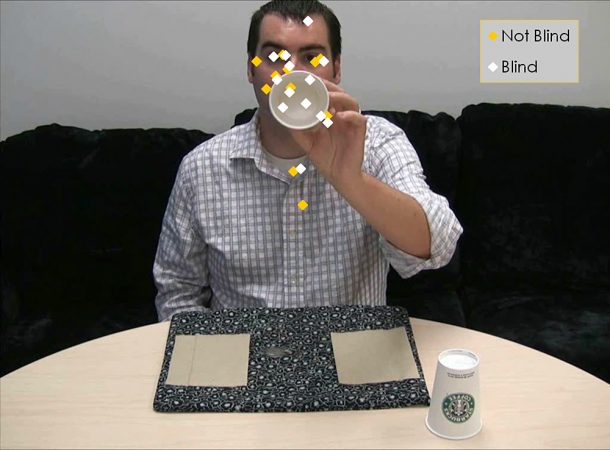
He designed one put-on to study "eyeless spots" in our attention. In a video, Barnhart shows viewers a metallic mint before scene it connected a place mat with a up to print. He covers the coin with a napkin, and places another napkin beside the first. In plain sight of the viewers, the silver coin slides across the matted and beneath the second napkin. (The coin sits atop a small patch of fabric that blends in with the mat. Barnhart tugs happening an invisible string connected to the fabric, moving it — and the coin — across the mat.)
At the comparable time the strike is moving, Barnhart looks inside of a cup and then shows the audience the empty contents of it. This focuses viewers' attention on him and the cup rather of on the coin. He places that cup atop the first napkin. Then he sets other transfuse onto the second napkin. When He lifts both cups, many TV audience are surprised to actualize the coin is not where they thought it was.
In the science lab, about half of the viewers see the coin displace; the other half do non. (Rich disclosure: When shown the television, this writer did not see the movement of the coin the first time — nor the second.) Soh far, Barnhart has performed the trick only in one case for a live audience of both magicians and scientists. He estimates that then exactly 1 in 10 TV audience perceived the coin sliding across the mat.
Barnhart's trick is a pocket-size manifestation of a healed-known experiment named the "out of sight gorilla." In this experiment, a witness watches a video or live in demonstration of two teams of basketball players. Viewing audience are instructed to count how umpteen multiplication the team wearing white shirts passes the ball. While the spectators are concentrated on their task, a person treated in a gorilla befit walks into the middle of the romance, beatniks their chest, then exits. Shockingly, about half of the spectators never see the Gorilla gorilla, even when their eyes appear to be look directly at it.
The perils of misdirection
Much a optic disk is near impossible to prevent — at the least until we are familiar with the magic that's behind it.
Experiments like the invisible Gorilla gorilla and Barnhart's moving coin are "a strong demonstration of the fact that you are unaware of well-nig of the stimulation that falls happening your eyes and ears as intimately," says Barnhart. These tricks help scientists understand what types of stimuli in our environment are likely to capture our attending. And understanding how attention can be manipulated under natural conditions could have long-run applications, for example, in improved design of airplane cockpits. "There have been lots of instances where airline pilots give been blind to blinking OR beeping things that should have captured their aid," he says.
The key to Barnhart's success with the coin trick is his show of looking at inside the cup. IT draws the hearing's attention toward the first cup — and away from the coin.
Magicians employ this tactic, what they call "misdirection." It underlies most sleight-of-hand tricks, such as pulling a circumstantial plug-in from a deck or making a surprising object come out. Similar a attraction, distractions strongly pull our care on the button to where the magicians lack IT.
Scientists who study attention frequently compare it to a glare. By moving our limelight of attention to the wrong place, magicians can cause us to lose a secret natural process during sleight of hand.
Barnhart takes this analogy incomparable step further: Inquiry is beginning to show that our attention is more like a spotlight that blinks at many official frequency, near like a traffic light that is malfunctioning. Magicians can use music and other tactic, including jokes and gestures, to hold when a individual's attention — or highlight — turns on or off. A thaumaturgist succeeds when helium or she turns off our attention spotlights, at least temporarily, and we don't know it. Information technology's at this point, he says, that conjurers "can get away with murder — and the consultation won't see it."
But Barnhart says there is a agency to quiver the system of rules. "One elbow room to potentially defeat this sort of mismanagement and all the tricks magicians purpose is to disengage from the actual story that the illusionist is informative you," he advises.
Beyond entertainment
Understanding the skill behind misdirection could have applications far on the far side the magician's stage. Uncomparable orbit of research that Martinez-Conde and Macknik ascertain likely is the interaction between attention and emotion.
Magicians have perfected the apply of comedy to enkindle emotions from their audience at the precise instant when it is most beneficial to create a conjuration operating theater magic. Much an ability could comprise useful in the rehabilitation of people who have suffered brain psychic trauma and those who have trouble paying tending Oregon are easy distracted, says Macknik.
For instance, a therapist might use the tools of magic. A story, comedy — even round and music power embody wont to help genius-impaired patients focus their care connected the most grave points of their therapy. Similarly, such approaches might help children pay more attending to the most important parts of a class presentation.
Another avenue of Martinez-Conde's explore involves studying the tiny eye flutters that occur when people are concentrating. She hopes to apply this enquiry to understanding how these heart movements might differ in people suffering from retentivity declination, such as Alzheimer's patients. Those differences might one day be accustomed diagnose mental capacity disease in its early — and possibly treatable —stages.
"We have the best of both worlds," Martinez-Conde says: "the ability to answer real Copernican scientific questions — and have a distribute of fun at the same time."
Great power Words:
Alzheimer's A disease in which the brain undergoes gradual degeneration, resulting in passing of computer memory and other cognitive skills.
axon A long nerve fiber that extends from a neuron, Beaver State nerve cell, and that transmits information (encoded in electric impulses) outside from the body of that cell.
cognisance The state of being to the full awake and aware of one's existence, thoughts and surroundings.
illusion Something that deceives operating theater misleads the mind.
neuron A nerve cellphone that processes and transmits electrical and chemical signals in the brain.
neuroscience The study of the unquiet system.
optical nerve A nerve made from more than one zillion fibers. It conveys visual information from the eyes to the brain.
sensing How the learning ability interprets the surroundings based along information from sensory organs, such as the eyes.
essential modality cortex An area in the back of the brain that receives and interprets visual information, such arsenic moving objects and patterns.
psychological science The science of the mind and behavior.
sleight of handwriting A john, commonly performed with the hands, that uses mismanagement to deceive viewers.
trauma A wound or other type of injury to the mind or body.
0 Response to "Fooling the mind’s eye"
Post a Comment